Upbeat Technology offers three evaluation boards built on its ultra-low-power RISC-V platform, helping customers accelerate development from always-on sensing and feature-rich AIoT products to drone flight control applications.
Each board is optimized for a different development focus:
- Trina-Pi is designed for ultra-low-power and always-on operation. It is well suited for battery-powered devices that need to monitor sound or sensor data continuously for long periods.
- Penta-Pi is a more advanced platform for wearables and AIoT development, with broader interface support for display, camera, audio, and external storage in more complex edge AI systems.
- Bluemag-Pi is a UP301-based flight control evaluation board designed for drone development. It supports PX4 Autopilot and Ardupilot, and it intrgrates dual IMUs, a magnetometer, a barometer, and multiple flight-control interfaces on a compact 4 cm x 4 cm board.
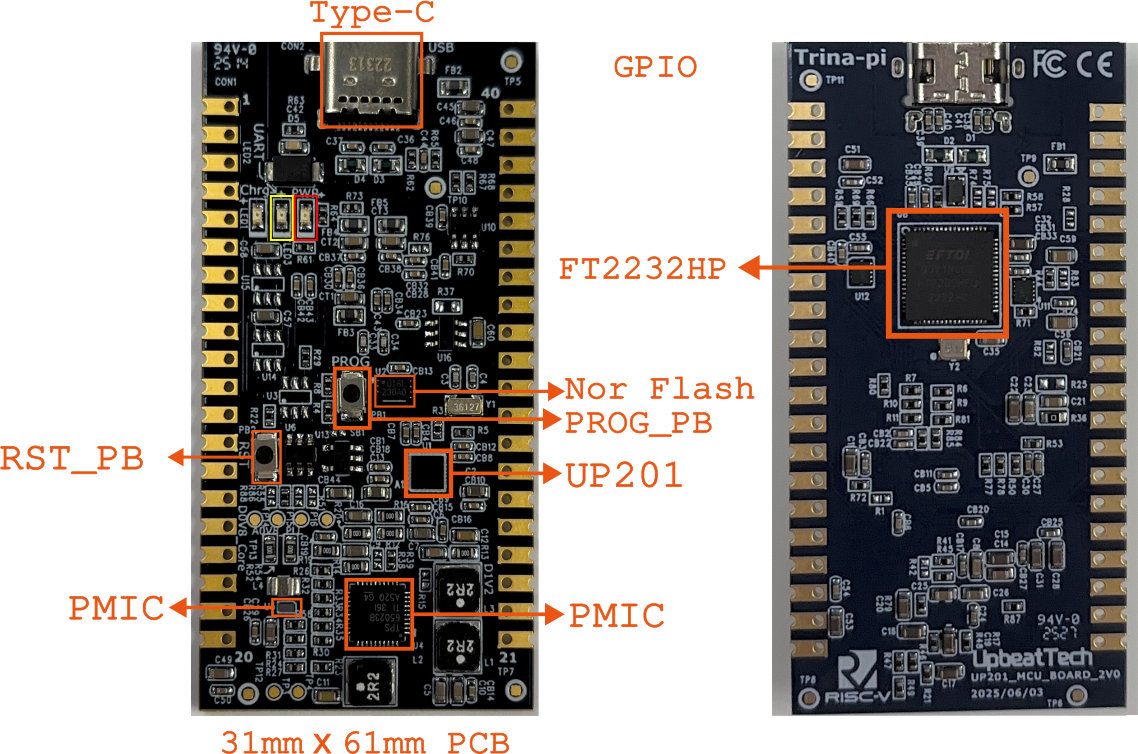
Trina-Pi
(UP201 Evaluation Board)
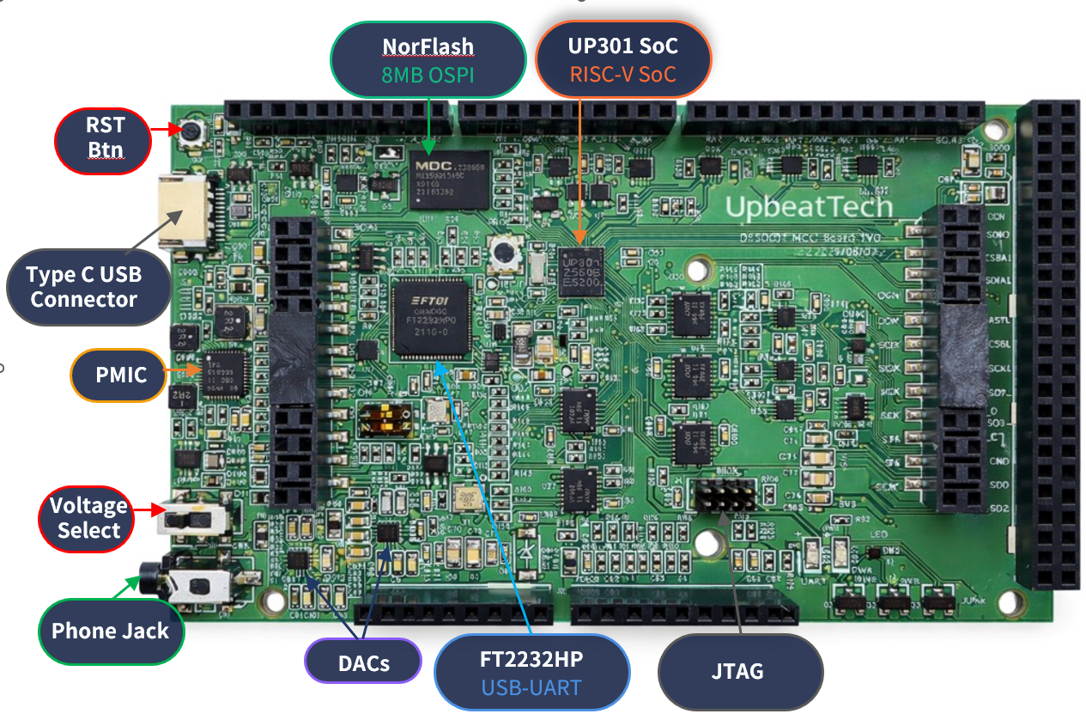
Penta-Pi
(UP301 Evaluation Board)
Board Advantages
- Ready-to-use evaluation platforms: All three boards let developers start evaluating the UP201 and UP301 platforms immediately, without designing custom carrier hardware first.
- Different levels of board integration: Trina-Pi keeps the hardware compact and focused for low-power prototyping, while Penta-Pi expands into display, camera, audio, and storage-heavy system evaluation.
- Practical expansion for prototyping: Trina-Pi emphasizes essential low-power I/O, while Penta-Pi adds richer board-level connectivity for more complete wearable and AIoT product bring-up.
General-Purpose Board Comparison
| SoC |
UP201 |
UP301 |
| On-board Flash |
2 MB QSPI NOR Flash |
8 MB OSPI NOR Flash |
| Board Size |
31 mm x 61 mm x 6.5 mm |
101.6 mm x 53.34 mm |
| Weight |
9.1 g |
38.9 g |
| Pin Count |
40 pins |
132 pins |
| Display Interface |
1x SPI |
MIPI DSI-2 |
| Audio Interface |
1x PDM, 1x I2S |
2x PDM, 2x I2S, DAC, phone jack |
| Storage Expansion |
On-board flash only |
SDIO 3.0, eMMC 4.5.1 |
Target Applications
- Trina-Pi: always-on voice detection, keyword spotting, vibration monitoring, sensor hubs, robotics control nodes, low-power IoT devices, and portable health or wearable prototypes.
- Penta-Pi: wearable and AIoT devices with displays, multimedia edge AI systems, camera-connected applications, portable medical devices, and products that need richer I/O and external storage.
Trina-Pi
Trina-Pi is a compact, ready-to-use evaluation board built around the UP201 ultra-low-power RISC-V SoC. It is designed for makers, embedded developers, and product teams that need to evaluate always-on sensing, low-power control, and lightweight on-device AI without first building custom hardware.
Compared with larger development boards, Trina-Pi is intentionally small and efficient. It is a practical platform for projects that must stay awake for long periods, monitor real-world signals continuously, and still remain within tight power budgets.
Trina-Pi Key Features
- Compact board size of 31 mm x 61 mm x 6.5 mm
- Lightweight design at 9.1 g
- Total 40 pins
- Powered by USB Type-C
- Includes 2 MB QSPI NOR Flash onboard
Trina-Pi Specifications
Physical
- Dimensions: 31 mm x 61 mm x 6.5 mm
- Dimensions (imperial): 1.220 in x 2.402 in x 0.256 in
- Weight: 9.1 g
Power and Storage
- Input: USB Type-C, 5 V
- Voltage outputs: 1.2 V / 1.8 V / 3.3 V
- Battery voltage detection range: 3 V to 5 V
- On-board flash: 2 MB QSPI NOR Flash
- Flash model: MX25U16356
Interfaces and I/O
- Communication interfaces:
- 2x UART
- 5x I2C
- 3x SPI
- 1x PDM
- 1x I2S
- Control and sensing:
- 20x GPIO
- 2x ADC, 12-bit
- 2x PWM
- Display interface:
Why Choose Trina-Pi
Trina-Pi is the better fit when the design priority is low power first. It gives developers a straightforward way to evaluate always-on sensing, local signal processing, and embedded AI behavior on a compact board with the essential interfaces needed for sensor-rich prototypes.
Penta-Pi
Penta-Pi is a ready-to-use evaluation board based on the UP301 ultra-low-power RISC-V SoC. It is designed for developers building wearable, AIoT, audio, and embedded products that need broader interface expansion, display support, external storage, and stronger multimedia integration than a minimal low-power board.
Trina-Pi focuses on compact always-on prototyping, Penta-Pi is meant for more complete system evaluation. It gives teams a larger hardware platform to explore richer user interfaces, audio pipelines, and connected edge AI designs before moving into custom product hardware.
Penta-Pi Key Features
- Powered by an onboard USB Type-C connector
- Includes 8 MB OSPI NOR Flash onboard
- Total 132 pins
- Supports expanded interface development for display, camera, audio, and storage
- Includes onboard PMIC, voltage selector, DACs, and phone jack
Trina-Pi Specifications
Physical
- Dimensions: 101.6 mm x 53.34 mm
Power and Storage
- Input: USB Type-C, 5 V
- Voltage outputs: 1.2 V / 1.8 V / 3.3 V
- Battery voltage detection range: 3 V to 5 V
- On-board flash: 8 MB OSPI NOR Flash
- Flash model: MX25UW6345G
- External storage support:
Interfaces and I/O
- Communication interfaces:
- 4x UART
- 5x I2C
- 2+1 SPI
- 2x PDM
- 1x I2S exposed in the general interface set
- Camera / SDIO / MIPI support
- Display interfaces:
- MIPI DSI-2
- LCD reset
- Backlight PWM dimming
- Touch interrupt
- Audio interfaces:
- 2x PDM-to-PCM
- 2x I2S at the SoC level
- Built-in DAC
- Phone jack output
Why Choose Penta-Pi
Penta-Pi is the stronger option when the evaluation needs go beyond ultra-low-power sensing and into complete edge AI systems. It is better suited for teams that need display connectivity, richer audio, camera support, and external storage while still staying within the same low-power RISC-V platform family.
Development Value
Together, Trina-Pi, Penta-Pi, and Bluemag-Pi provide flexible evaluation platforms for a wide range of embedded applications. Trina-Pi offers a compact solution for ultra-low-power and always-on products, Penta-Pi supports interface-rich AIoT and wearable systems, and Bluemag-Pi extends the UP301 platform into drone flight control with PX4 Autopilot and Ardupilot support and intergrated navigation sensors. Learn more about the Bluemag-Pi flight control evaluation board.

